The genus
>
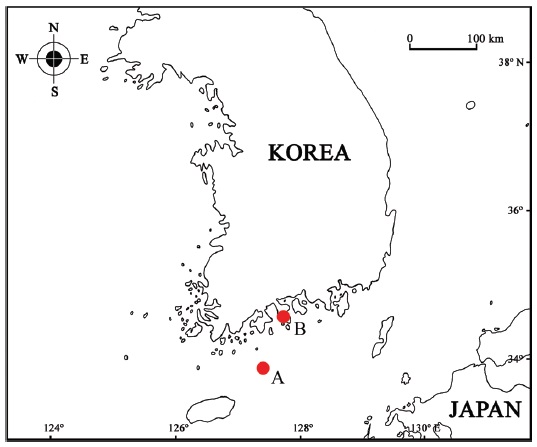
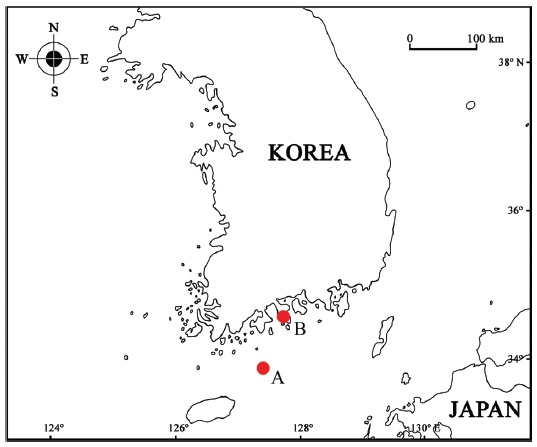
Material examined. Korea, 1♂: Jeollanam-do: Yeosu-si, Samsan-myeon, Seodo-ri, Seodo Port, 34°03′01″N, 127°17′53″E, 17 Apr 2009, Kim YH; 1♂, Yeosu-si, Dolsan-eup, Yulrim-ri, Impo Port, 34°35′35″N, 127°48′27″E, 23 Jun 2011, Kim NH, Hong SS; 4♂♂, 1 Juv.♂, Yeosu-si, Samsan-myeon, Geomun-ri, Geomun Port, 34°01′38″N, 127°18′30″E, 30 May 2014, Hong SS, Kim SH.
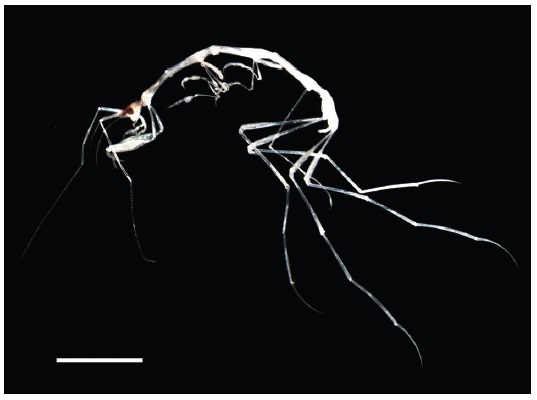
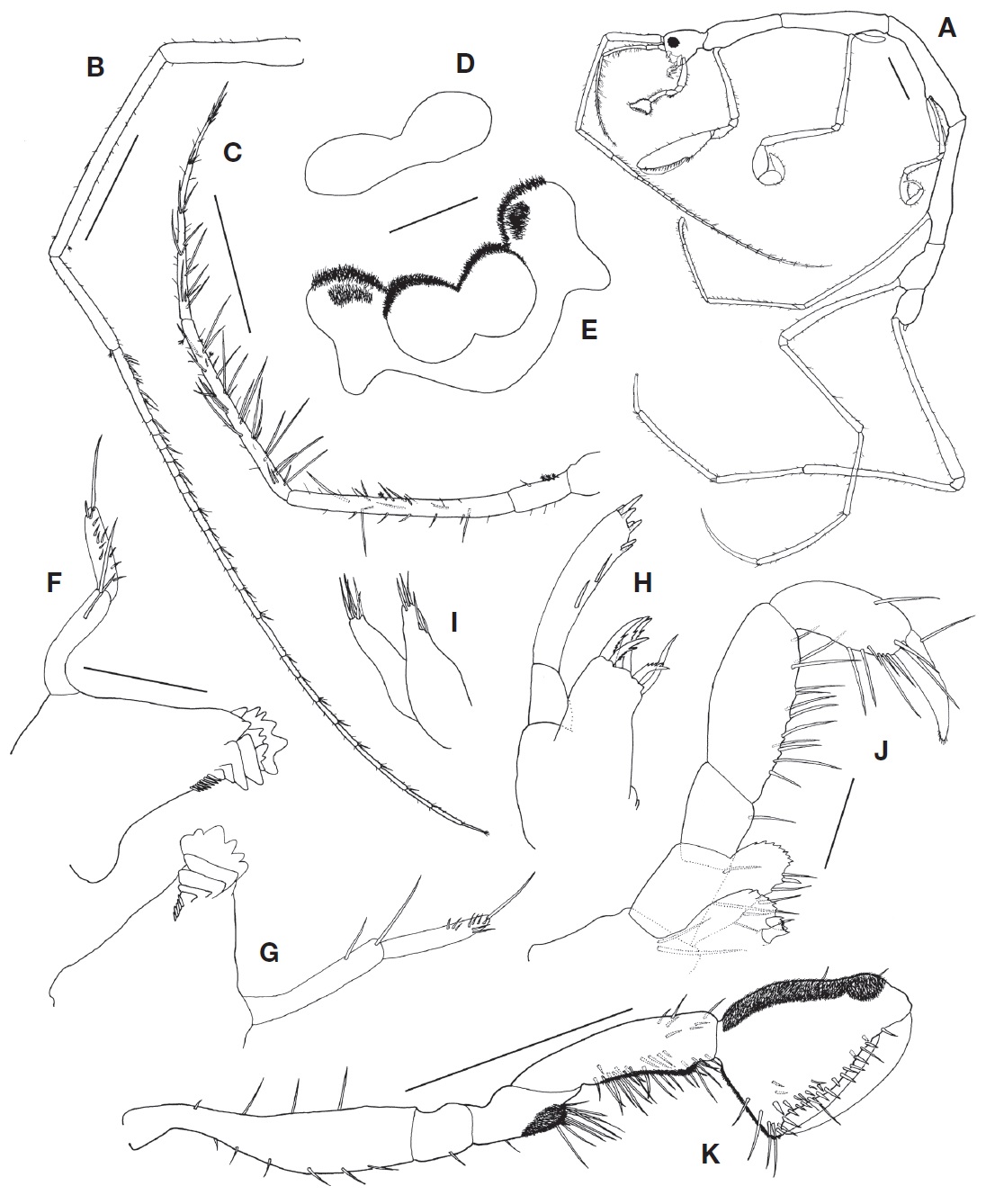
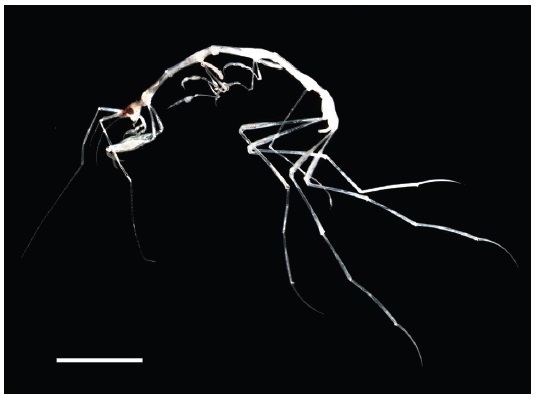
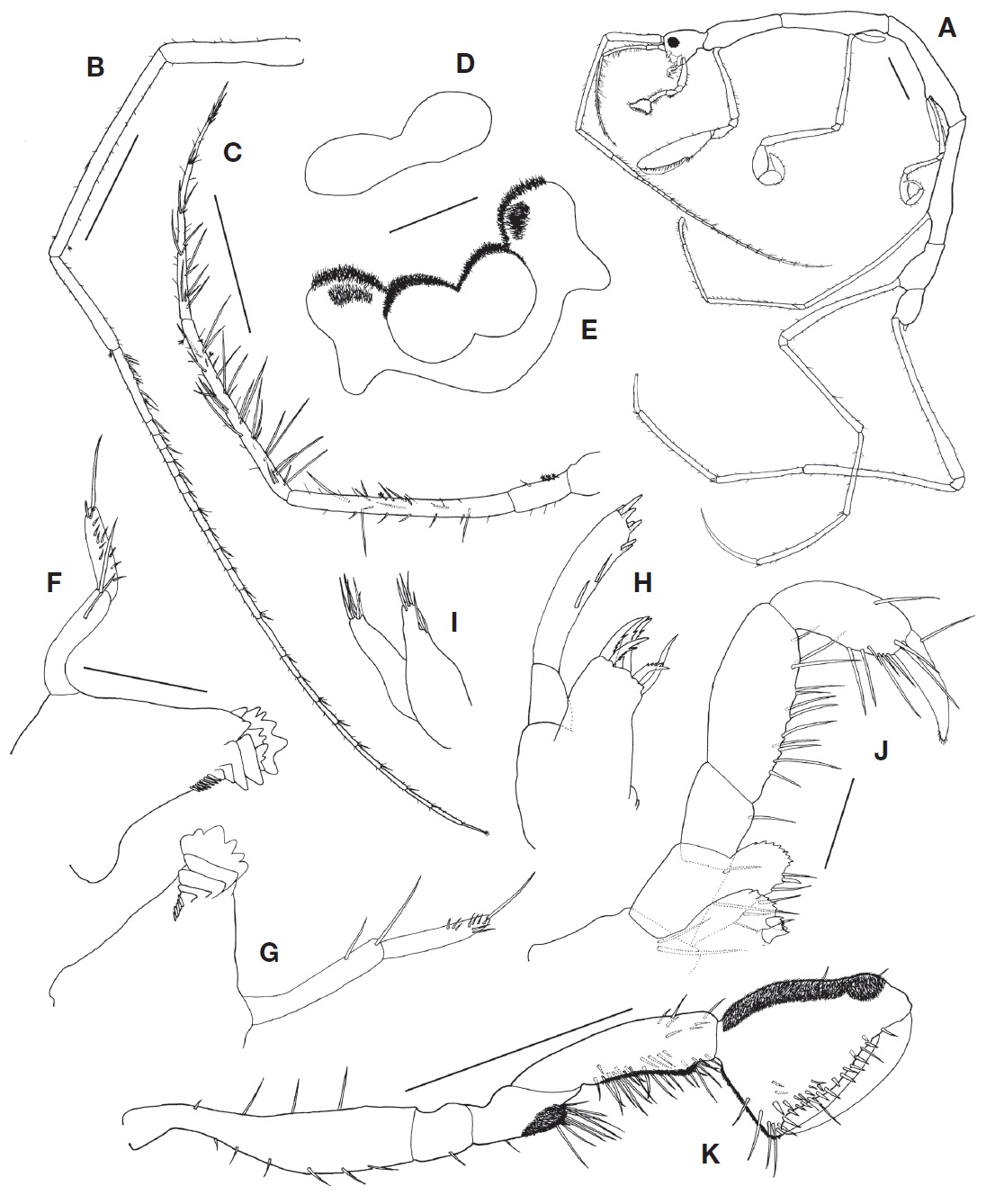
Description. Male (cat No. NIBRIV0000416866): Body (Figs. 2, 3A) slender, 12.0 mm long. Head smooth without process. Eye large, round. Pereonite 1 fused with head, suture not present. Pereon slender, smooth; pereonites 3-4 with 6-articulate appendages and gills; length ratio of pereonites 2-7=1.00 : 1.44 : 1.69 : 1.69 : 0.62 : 0.50.
Antenna 1 (Fig. 3B) 0.78× body; length ratio of peduncular articles 1-3=1.00 : 1.67 : 0.80; flagellum 22-articulate, 1.24× peduncle, each article with 1 aesthetasc ventrodistally.
Antenna 2 (Fig. 3C) setose, much shorter than antenna 1; length ratio of peduncular articles 3-5=1.00 : 3.77 : 3.38; flagellum triarticulate, 0.49× peduncular articles 3-5.
Upper lip (Fig. 3D) rounded, notched midventrally.
Lower lip (Fig. 3E) well developed, inner and outer lobes with patch of pubescence apically.
Left mandible (Fig. 3F) incisor 6-teethed, lacinia mobilis well developed, 5-teethed, setal row with 7 setae, followed by 4 plates, lacking molar; mandibular palp slender, biarticulate, article 1 with 2 long simple setae distally, article 2 about 0.7× article 1, with 1 long simple seta apically and 11 short setae subdistally.
Right mandible (Fig. 3G) similar to left one, except incisor 6-teethed, lacking lacinia mobilis and setal row with 5 setae.
Maxilla 1 (Fig. 3H) inner plate absent; outer plate with 6 stout setal teeth (5 serrate and 1 simple) apically; palp biarticulate, distal article elongate, 2.78× proximal article.
Maxilla 2 (Fig. 3I) inner plate with 3 apical and 2 subapical setae; outer plate subequal to inner one, with 5 simple setae apically.
Maxilliped (Fig. 3J) inner plates fused with suture, subrectangular, serrate distally, with 2 robust nodular setae apicomedially; outer plate serrate distally, with 5 medial setae; palp massive, 4 articulate, article 2 longest, with simple seate medially.
Gnathopod 1 (Fig. 3K) merus with pubescence and 9 simple setae midposteriorly; carpus subrectangular, setose, posterior margin pubescent; propodus subtriangular, widening distally, covered with patch of pubescence dorsally, palm slightly convex, with stout setae, proximal projection conspicuously provided; dactylus falcate, fitting palm; length ratio of 6 articles=1.00 : 0.21 : 0.25 : 0.68 : 0.65 : 0.54.
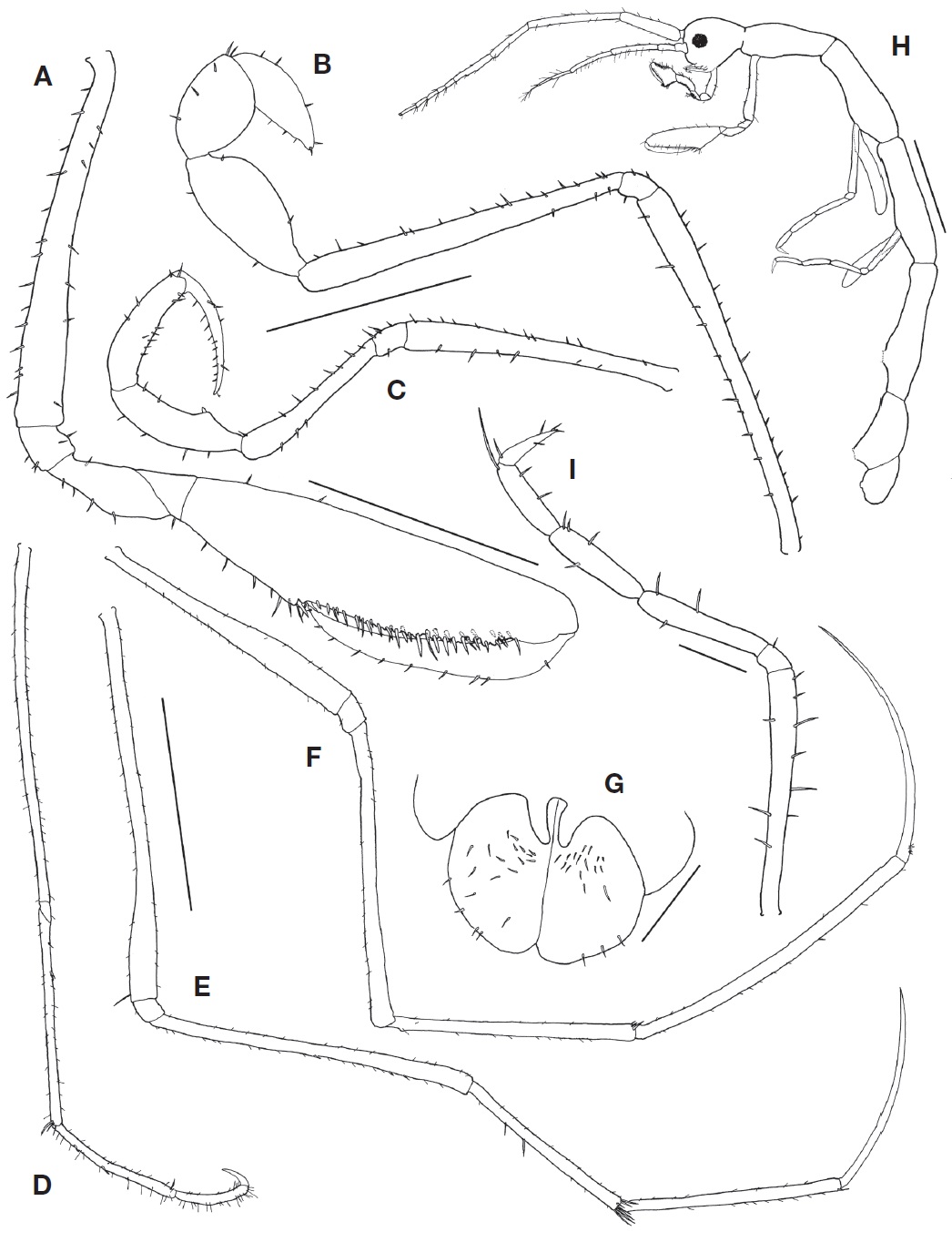
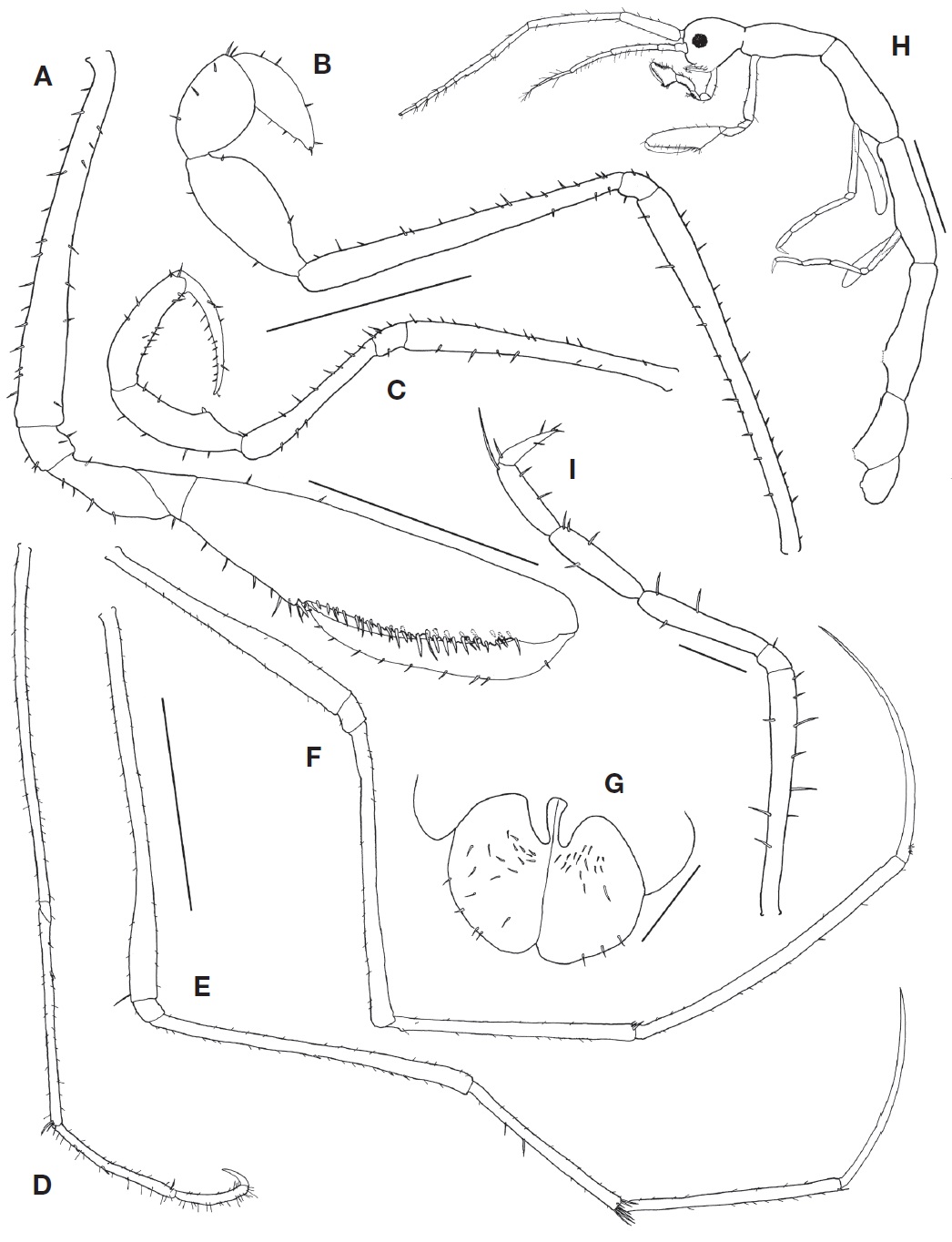
Gnathopod 2 (Fig. 4A) long and slender; propodus longish elliptical, width 0.23× length, palm longer than posterior margin, with simple setae on palmar margin; dactylus fitting palm; length ratio of 6 articles=1.00 : 0.10 : 0.26 : 0.10 : 1.06 : 0.71.
Pereopod 3 (Fig. 4B) 2.35× pereonite 3; basis to merus slender; carpus, propodus, and dactylus roundly swollen generally; length ratio of 6 articles=1.00 : 0.09 : 0.86 : 0.40 : 0.28 : 0.28.
Pereopod 4 (Fig. 4C) 1.38× pereonite 4; similar to pereopod 3, but carpus, propodus and dactylus not swollen; carpus with 1 ventral stout seta; length ratio of 6 articles=1.00 : 0.12 : 0.61 : 0.49 : 0.46 : 0.44.
Pereopod 5 (Fig. 4D) slender, elongate, 6-articulate; 2.89× pereonite 5; length ratio of 6 articles=1.00 : 0.05 : 0.58 : 0.40 : 0.22 : 0.08.
Pereopod 6 (Fig. 4E) slender, elongate, 6-articulate, 10.8× pereonite 6; length ratio of 6 articles=1.00 : 0.06 : 0.84 : 0.49 : 0.58 : 0.57.
Pereopod 7 (Fig. 4F) slender, elongate, 6-articulate, 15.2× pereonite 7; length ratio of 6 articles=1.00 : 0.09 : 1.09 : 0.86 : 1.16 : 0.98.
Penes (Fig. 4G) cylindrical, situated medially, width 0.4× length.
Abdomen (Fig. 4G) lacking appendages.
Immature male (cat No. NIBRIV0000416867): Body (Fig. 4H) 6.5 mm long. Body form general as in mature male; length ratio of pereonites 2-7=1.00 : 1.28 : 1.50 : 1.55 : 0.78 : 0.50.
Pereopod 3 (Fig. 4I) slender, differs from that of mature male; 1.33× pereonite 3; carpus, propodus and dactylus not swelled; length ratio of 6 articles=1.00 : 0.09 : 0.54 : 0.44 : 0.34 : 0.26.
Distribution. Chuen Island, Thailand (Mayer, 1903; McCain and Steinberg, 1970), East China Sea, Korean Straits, East Jeju Island, Western Goto Islands (Arimoto, 1980), Phuket (Guerra-García, 2004) .
Remarks. The genus
Korean name:1*두아가미원시바다대벌레속, 2*두마디원시바다대벌레